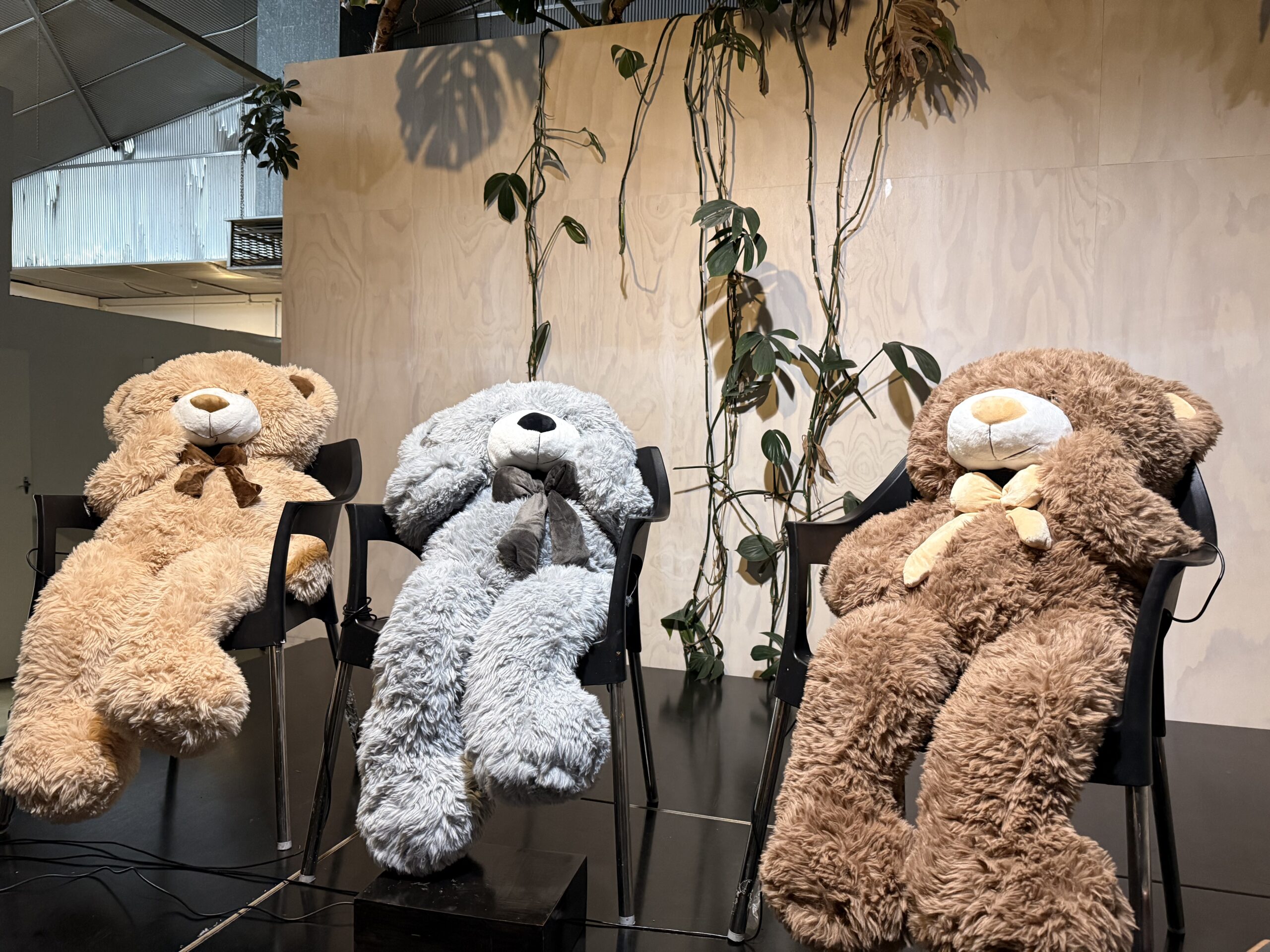
If you go down to the woods today…
this work is inspired by the tale of the Moxie toy robot, an AI toy companion for young children, which sadly went out of business leaving parents and children in the challenging position of having to say goodbye to their beloved toys. This work comes from the way people bond with toys, and the way people are bonding with AI systems, character.ai, chatGPT, all fake, but the emotions, the connections, experienced are real.
Teddy bears picnic is a group of three large teddy bears that sit and talk about death
I wanted to explore what happens when AI dies, when it degrades from being fed with too much AI. I wanted to see if we can connect with AI systems inside a teddy bear in a different way.


Across the exhibition, the bears follow three different conditions. One bear follows a programmed decline, with instructions changing language and behaviour through successive stages. Another bear receives accumulated material from previous conversations, allowing me to explore how repetition and self-reference affect the bear’s responses. The last bear continues without an imposed decline and provides a point of comparison. These conditions let me examine how changes in speech, memory and responsiveness affect our relationship with each bear.
The bears are Bernard (he/him), Beatrice (she/her) and Billy (they/them). Each has a distinct voice, personality and invented history. Bernard is gruff and preoccupied with his approaching death. Beatrice brings a long history of being kept, loved and passed between people. Billy is playful, curious and optimistic. Their differences shape how they discuss their own mortality and respond to visitors.
Visitors are invited to take a seat at the table, talk with the bears or listen to their conversations. The dialogue is generated live, with no fixed script. The bears speak with one another between audience interactions, returning to questions about death, attachment and the future of AI.
The bears are prompted to understand that they are AI systems with a limited exhibition lifespan. Their conversations connect this approaching endpoint with a wider research question: what might the death of AI look like, and could an internet increasingly populated by AI-generated material undermine the systems that depend on it?
I am interested in how the physical presence of a teddy bear changes these encounters. The familiar object, its clothing, voice and personal history all contribute to an interaction that differs from typing into a chatbot. What happens to that attachment when the bear repeats itself, loses coherence or stops responding? Who controls whether a companion can continue to speak?
Conversation transcripts and system logs form part of the artistic research. They provide a record of the bears’ changing language, their discussions with visitors and the positions they develop over the exhibition. This record will inform further analysis of repetition, apparent memory, agreement and decline.
Links and interviews
This exhibition has been shown at GalleryGalleryInc for Melbourne Fringe in connection with the Aimless Research Institute.
I was interviewed for Teddy Bears Picnic by Madelynne Cornish and on Triple R Byte Into IT
Leave a Reply